As a former government payer, this is a question I have been asking myself since the recent CMS publication of IPAY 2028 negotiated Maximum Fair Prices (MFPs).
While the Inflation Reduction Act (IRA) CMS Medicare Drug Price Negotiation Program (MDPNP) is somewhat a reverse Health Technology Assessment (HTA) process (markets typically do this type of assessment at a drug’s launch, not the end of life), it serves the purpose of setting a pre-defined willingness to pay based on incremental benefit and comparative efficacy. This latter part is important. I believe, just like with HTA, we are starting to see the negotiation framework based on previously assessed products.
In this article Verpora’s payers and analysts explore how negotiations have evolved over years for cancer treatments and examine what it signals for manufacturers preparing for future negotiations.
1. Three years of CMS negotiated prices are beginning to reveal a pattern: pharmaceutical companies should be watching closely
With CMS now having announced negotiated MFPs for Initial Price Applicability Years 2026, 2027 and 2028, we looked specifically at the cancer treatments (oncology plus hematology) across the three cycles.
Now, the focus for CMS seems to be firmly on the visible headline discounts from gross to net and whether or not the government is becoming more aggressive as it develops familiarity with the negotiation process, and guidance moves to rulemaking.
However, something equally interesting is arising, and arguably more important; - that is the relationship between negotiated prices within similar classes of MFP products.
2. Is Medicare negotiation gradually moving beyond individual product negotiation toward therapeutic-class price anchoring, especially for cancer treatments?
Cancer treatment is becoming much more prominent.
In the first negotiation cycle, cancer treatments represented just one of the ten selected products with negotiated prices: Imbruvica.
By 2027, four of the 15 negotiated products were cancer treatments: Xtandi, Pomalyst, Ibrance and Calquence. ¹ ²
For 2028, four of the 13 products for which CMS reports an MFP in the release are cancer medicines: Erleada, Kisqali, Verzenio and Lenvima.
Cancer treatment have moved from 10% of the first negotiated cohort to roughly 1/3rd of the subsequent priced cohorts
And that matters because cancer treatments combine relatively small Medicare populations with extraordinarily high expenditure.
For example, in the 2028 cohort, CMS reports approximately $2.08 billion in Medicare expenditure for Erleada across just 19,000 users, while Lenvima generated approximately $1.14 billion across only 10,000 patients.³
In other words, high-cost cancer treatment remains an obvious target for the program even where patient numbers are comparatively small. The revenue driven by high-cost drugs and small populations frames a different paradigm from drugs like GLP-1s which represent medium cost with very high volume when negotiating value on the backdrop of a shift toward population health.
3. The discounts themselves are not the most interesting numbers; it’s the therapeutic class relationship
Across cancer treatment, the reported negotiated discounts are:
| 20261 | 20272 | 20283 | |||||
|---|---|---|---|---|---|---|---|
| Brand & Discount | Brand & Discount | Brand & Discount | |||||
| Imbruvica | 38% | Xtandi | 48% | Erleada | 51% | ||
| Pomalyst | 60% | Kisqali | 43% | ||||
| Ibrance | 50% | Verzenio | 44% | ||||
| Calquence | 40% | Lenvima | 46% | ||||
Clearly, these reductions are generally less dramatic than the 70%-85% headline reductions seen for some high-volume non-cancer products*. However, given operating in cancer has traditionally been viewed as a 3rd rail when it comes to contracting (i.e. zero to single-digit discounts and a protected class) these discounts represent a significant reset to this trend with the silent thought screaming out loud; what happens in government, bleeds into commercial.
*Important caveat: CMS reports 2026 and 2027 discounts against list price/WAC, whereas the 2028 release reports discounts against 2025 Medicare gross cost) Comparisons of the percentage discounts across years therefore need to be treated carefully.¹ ² ³
In addition to this, the much more intriguing signal comes from the absolute MFPs.
4. The $7,004 question
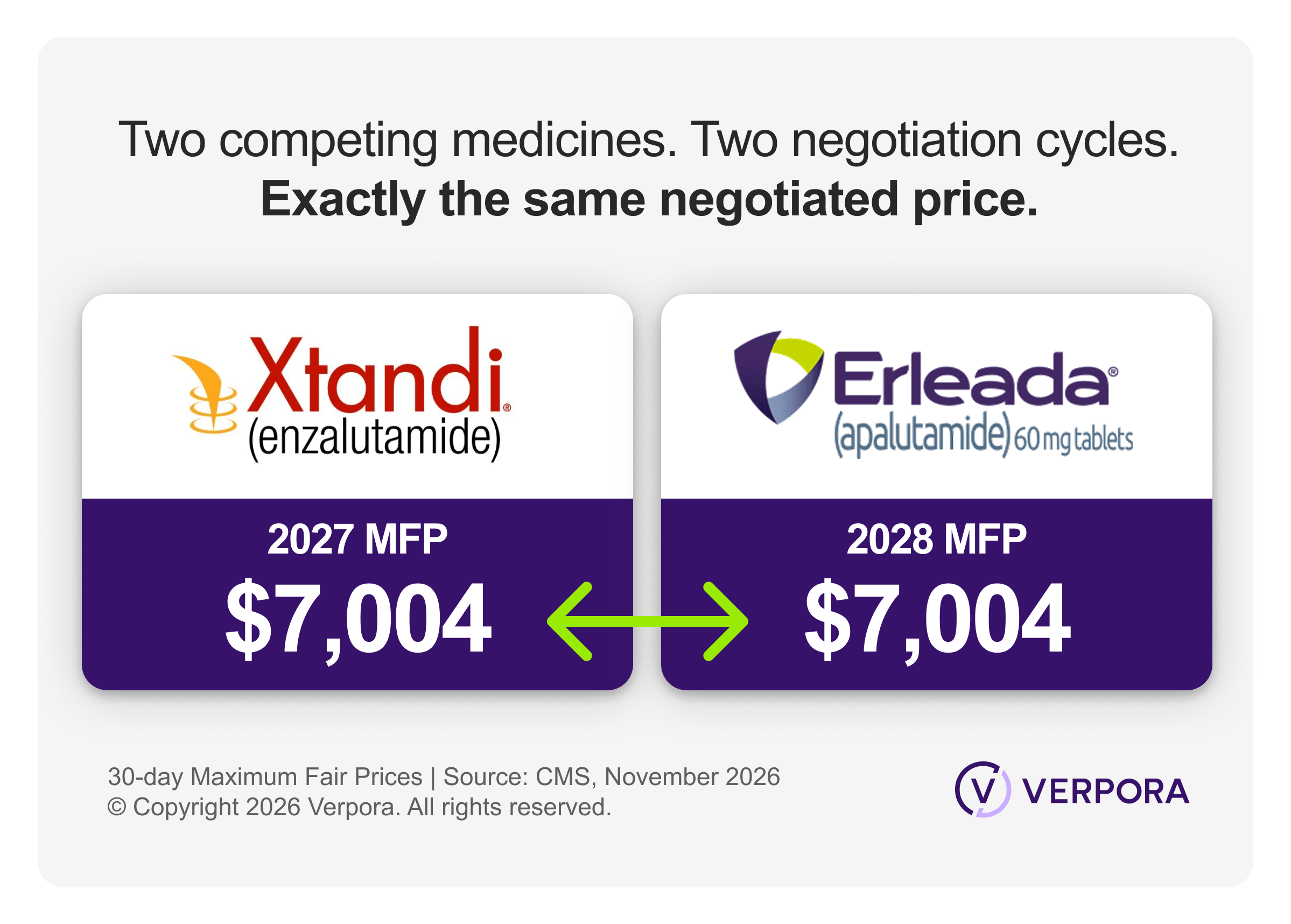
Let’s consider prostate cancer. For 2027, CMS negotiated Xtandi from a reported benchmark of $13,480 to an MFP of $7,004.
One year later, Erleada enters negotiation. Its reported benchmark is $14,253.
The resulting MFP? $7,004
Exactly the same 30-day negotiated price.² ³
Is this a coincidence? Possibly, yes. Probably, not.
So what’s happening?
CMS's own methodology makes the comparison particularly interesting. CMS explicitly states that where a drug from an earlier negotiation cycle is subsequently identified as a therapeutic alternative to a newly selected drug, the previously negotiated price could serve as an input into development of the initial offer for that subsequent drug². That makes the Xtandi/Erleada relationship difficult to ignore.
Let’s explore this further…
5. CDK4/6 breast cancer
There is potentially an even more interesting pattern in breast cancer.
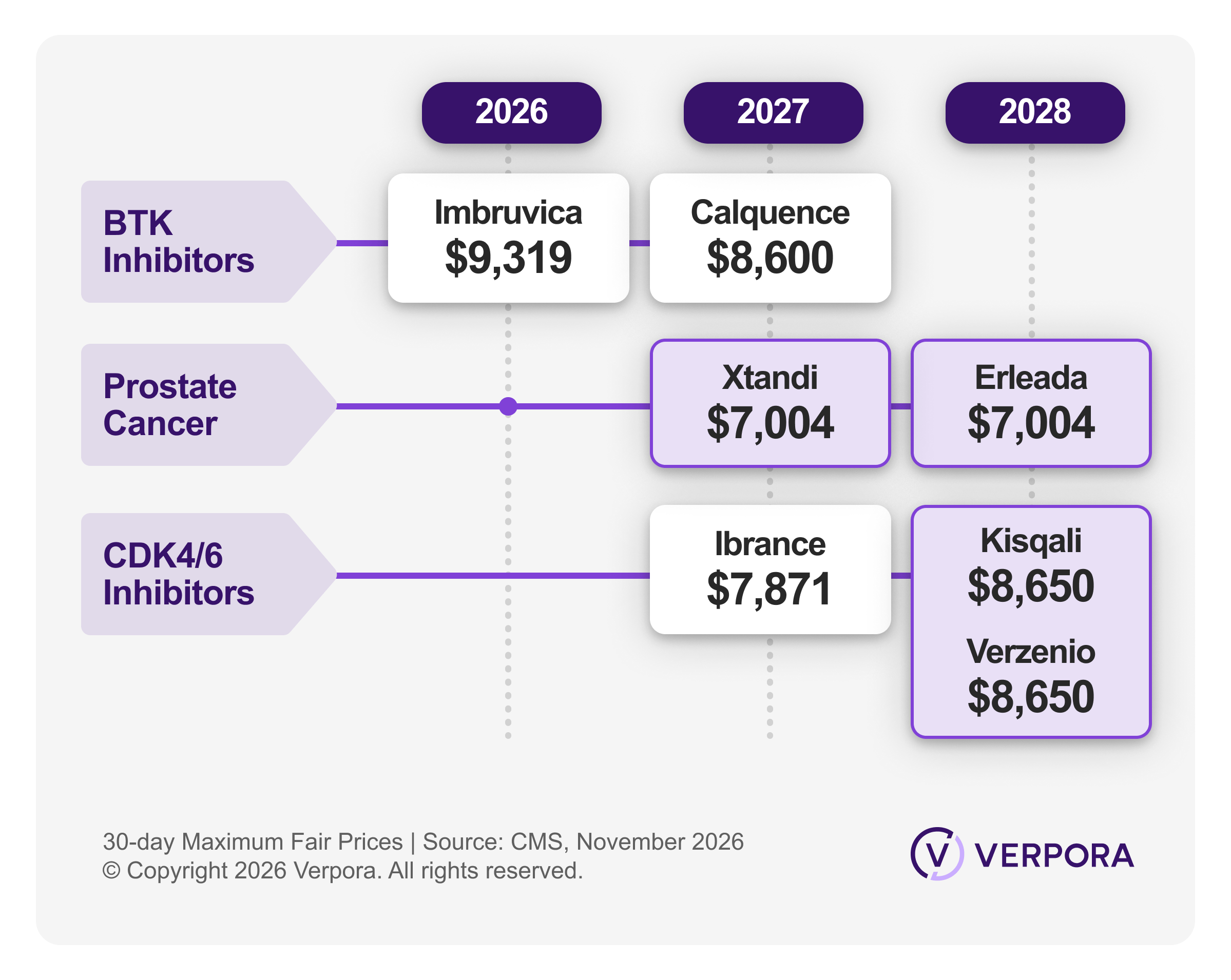
Ibrance was negotiated for 2027² : $7,871
Then, for 2028, two more CDK4/6 inhibitors enter the program³ :
Kisqali: $8,650
Verzenio: $8,650
Again, two competing products arrive at exactly the same MFP. Interestingly, CMS did not simply replicate Ibrance's earlier $7,871 MFP. Instead, the two subsequent products converge at a common but higher $8,650 price point.
That distinction could be important. It suggests that if therapeutic referencing is occurring, it may not operate as a simplistic "take the lowest existing MFP" rule.
Rather, CMS may be using negotiated comparator prices alongside evidence on therapeutic alternatives, therapeutic advances, comparative effectiveness, unmet need and other statutory factors to establish something resembling a therapeutic-class negotiating corridor. CMS confirms that these clinical and economic considerations form part of its negotiation process.² ³
6. Hematology
Let’s look at an earlier example with Imbruvica, negotiated for 2026, and received an MFP of: $9,319
Calquence then followed in 2027 with an MFP of: $8,600.¹ ²
Both compete within BTK-inhibitor-treated B-cell malignancies, including CLL/SLL.
The pattern is therefore beginning to repeat across several competitive cancer treatment environments:
What does this mean for pharmaceutical companies who find themselves in the crosshairs of CMS MDPNP? And arguably, the downstream (and upstream) implications for those cancer treatment brands who are undergoing formulary bids with products competing within therapy baskets which have MFP products within them? The answer lies in how these frameworks are defining what value means for cancer medicines.
7. Could this create a Medicare value-based price reference for cancer medicines?
This is where the strategic implications become particularly interesting.
Every completed negotiation potentially gives CMS something it did not have previously:
a publicly established, government-negotiated price for a therapeutic alternative.
CMS can then potentially use that information when negotiating the next product. Over successive cycles, the process could look something like this:
The implication is important.
CMS's negotiating power may strengthen over time even without a fundamental change to the statutory framework, simply because each cycle provides more negotiated precedents. The accumulated effect of multiple MFP products across cancer treatment baskets generates lower ceiling prices, lower net prices and this will dictate initial offers and guardrails for the 9-month negotiations that will commence. The battle lines are drawn and field of play is increasingly restricted; and dare we suggest it, brand revenue is capped.
The strategic question for Pharma negotiations will change.
Historically, a manufacturer preparing for CMS Medicare negotiation might naturally ask:
Increasingly, another question could become equally important:
That is a very different problem to navigate. It moves negotiation preparation away from a predominantly product-specific discount exercise and toward competitive therapeutic-class scenario negotiation.
Manufacturers may therefore need to understand not only their own likely statutory ceiling and evidence package, but also:
which products CMS could consider relevant therapeutic alternatives;
the MFPs already established for those alternatives;
differences in comparative clinical value;
areas of therapeutic advance or unmet need that support differentiation;
how previous CMS negotiations may anchor the initial offer;
and where a defensible class-level price corridor could ultimately emerge.
Over the years, our experience in IRA CMS MDPNP has shown that the arguments for removing a therapeutic alternative may not rest on the belief that the brand is superior. For example, CMS will be using it’s own utilization data (which is unlikely to match yours, and they’re unlikely to share how they got theirs). Your belief that generic chemotherapy is toxic and outdated and should never be compared to your brand may not be aligned with current NCCN/ASCO guidelines, physician prescribing patterns, and the available published evidence.
8. 2028 introduces another important change
The first two negotiation cycles focused on selected Part D drugs. For 2028, the program expands to drugs payable under Medicare Part B and/or covered under Part D.³
That has particular significance for cancer treatment.
Much of cancer treatment expenditure sits within physician-administered Part B medicines. The program therefore now has the structural ability to move beyond predominantly oral/self-administered cancer medicines and increasingly reach infused and injected cancer treatment therapies in future cycles.
The potential exposure of cancer treatment to Medicare negotiation is consequently becoming significantly broader, and already there are system-wide narratives around Part B effectuation prices on ASP reimbursement issues for rural clinics, smaller private cancer treatment practices, de-prioritization from formularies to brands with improved economics and impact on future generics/biosimilars looking for market entry.
In conclusion: three years into IRA Medicare Drug Price Negotiations
It is still early. Nine oncology and haematology products across three cycles are nowhere near enough to infer a formal CMS pricing algorithm.
Nor should identical MFPs automatically be interpreted as evidence of explicit reference pricing. CMS considers multiple statutory factors, and individual negotiations remain product-specific.¹ ² ³
Nevertheless, we are observing three clear signals which are becoming difficult to dismiss:
That third observation could become particularly important, because Medicare negotiation may not simply be creating a series of lower individual drug prices.
It could gradually be creating a negotiated therapeutic reference price for current and future cancer treatments . When payers implement HTA styled frameworks, rather than seeing ever-decreasing drug prices, we tend to witness pricing corridors gravitate and settle as the medicine’s value becomes defined by metrics consistent with incremental benefit and comparative efficacy within therapy baskets.
As we move forward, one thing has become apparent. Pharmaceutical companies are fighting to preserve value, on an individual basis, brand by brand. But CMS is negotiating as a system.
Sources
Centers for Medicare & Medicaid Services (CMS). Medicare Drug Price Negotiation Program: Negotiated Prices for Initial Price Applicability Year 2026. Available at CMS.gov. (Accessed: 26 November 2026).
Centers for Medicare & Medicaid Services (CMS). Medicare Drug Price Negotiation Program: Negotiated Prices for Initial Price Applicability Year 2027. Available at CMS.gov (PDF). (Accessed: 26 November 2026).
Centers for Medicare & Medicaid Services (CMS). Medicare Drug Price Negotiation Program: Negotiated Prices for Initial Price Applicability Year 2028. Available at CMS.gov (PDF). (Accessed: 26 November 2026).

About Verpora
Verpora has assisted pharmaceutical and biotechnology companies with the Medicare Drug Price Negotiation Program since its launch. The company's team of former government payers, negotiation experts and analysts help manufacturers pressure-test their value story, plan for different pricing scenarios, and develop the negotiation strategy plus skills to optimize success.

About the Author, Omar Ali
Omar Ali is Head of Payers at Verpora and a former adviser to the UK’s National Institute for Health and Care Excellence (NICE). Drawing on a decade of health technology assessment work at NICE and more than a decade helping U.S. pharmaceutical manufacturers build their payer clinical value stories and execute Pharmacy Benefit Manager (PBM) negotiations, Omar has helped manufacturers prepare for the first three rounds of the Medicare Drug Price Negotiation Program.
Meet the Team → Omar Ali